
Radon in the basement
Causes, risks and solutions for radon in basements in Germany; the comprehensive guide from Haustrocknung.de - your expert for radon measurement, radon reduction and basement dehumidification


Radon - the invisible risk in many houses
Core statements
- Radon is a colorless and odorless noble gas. It is produced when uranium decays in the ground and enters the building through leaks in the foundations.
- Alongside smoking, radon is the most common cause of lung cancer. Countermeasures should be taken from a concentration of 300 becquerels per cubic meter.
- Effective countermeasures include ventilation, sealing cracks and pipe penetrations as well as radon ventilation or radon drainage.
1. What is radon?
Radon is a radioactive noble gas that is produced when uranium decays in the ground. It rises with the soil air and enters buildings through the smallest of leaks. Particularly affected are
- Cellar
- Basement rooms
- Older buildings
- Poorly sealed
- Base plate
- Houses in radon risk areas
Radon is produced by the decay of uranium 238, which is found in many rocks. The most important factors for high radon levels:
- Uranium-rich rocks (granite, gneiss, slate)
- Loose, well-drained soil
- Fissures and crevices underground
- Damp floors and walls
- Poor sealing
The radon concentration can vary greatly depending on the geological situation.
Radon penetrates via the same pathways as moisture:
- Cracks in the floor slab
- Leaky pipe penetrations
- Joints in masonry
- Natural floor cellar
- Manholes and seepage pipes
- Pump shafts
- Sewage pipes
- Radon is seven times heavier than air
- Negative pressure in the building
- Tight windows and doors
- Damp walls
- Poor ventilation
Radon and moisture reinforce each other:
- Damp walls → more porous → more radon
- Poor ventilation → Radon accumulates
- Renovations without ventilation → Radon increases
Haustrocknung.ch specializes in the combination of:
- Basement drying
- Radon reduction
- Automatic cellar ventilation
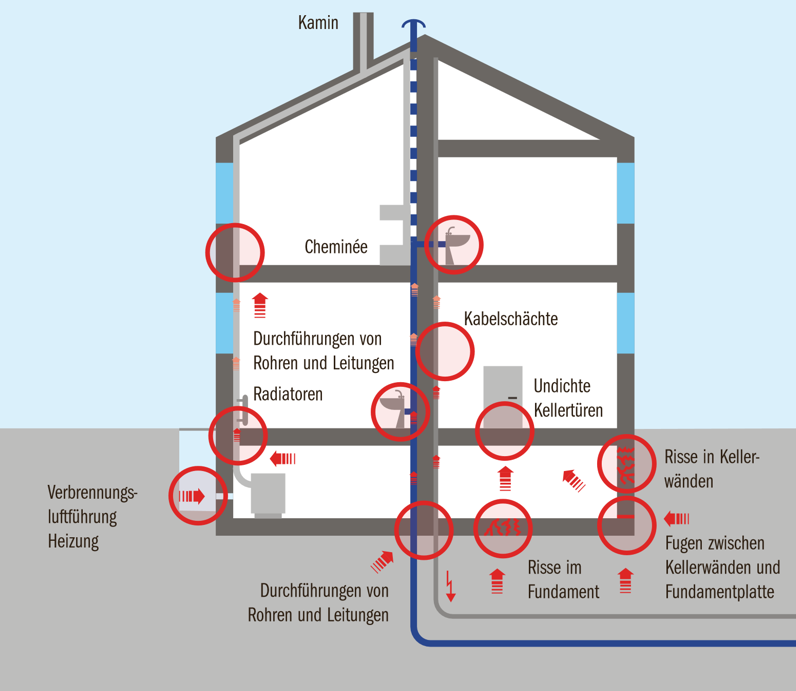
Radon enters the house via the basement.
2. How dangerous is radon for humans?
Radon is the second most common cause of lung cancer after smoking.
Particularly at risk:
- Smoker
- Children
- Older people
- People who spend a lot of time
- Basement or first floor
Radon itself is largely exhaled when inhaled. The decay products (polonium, bismuth, lead), which are deposited in the lungs and emit alpha radiation there, are dangerous.
3. What radon limit values apply in Germany?
4. Radon map: Where is a high radon risk in Germany?
Germany is one of the countries with an increased radon potential, although the risk is distributed very differently geographically. The highest risk exists in the low mountain ranges with granitic subsoil and in regions with historical mining. The Erzgebirge (Saxony), the Black Forest (Baden-Württemberg), the Fichtelgebirge and the Bavarian Forest (Bavaria) as well as the Harz Mountains are particularly affected.
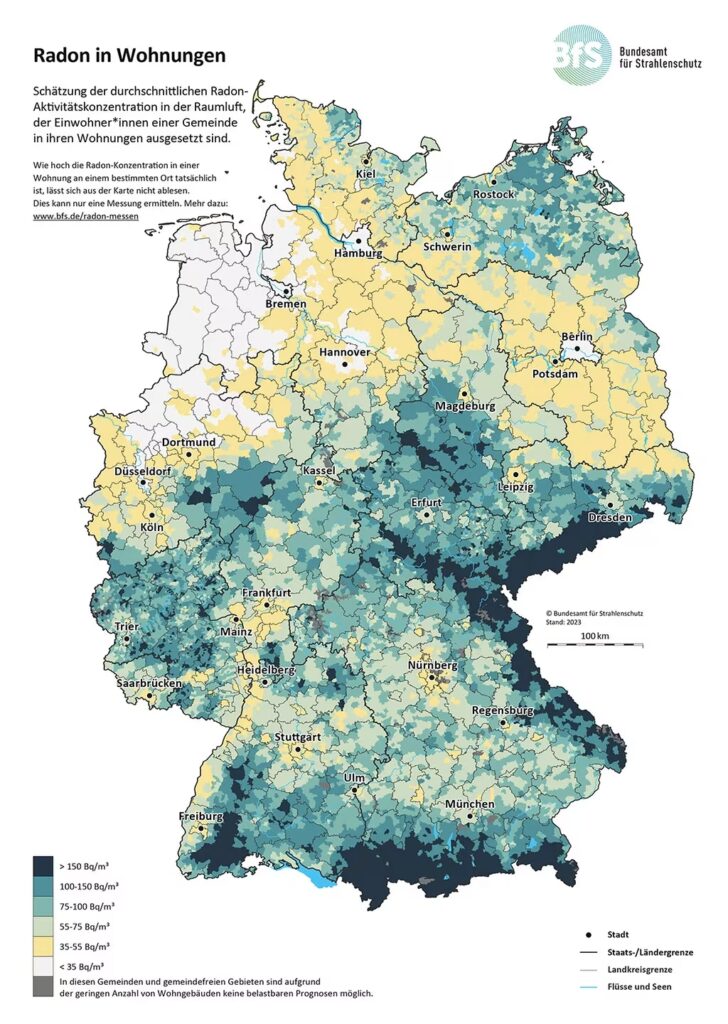
Radon in homes in Germany (source: BfS): Estimation of the radon concentration in living spaces, interactive map
5. How can I measure radon?
Radon measurement is simple and reliable.
Passive measurement (dosimeter)
- At least 90 days
- Ideal in winter
- Cost-effective
- Very reliable
Active measuring devices
- Real-time measurement
- Ideal for remediation control
Short-term measurements
- 2-4 weeks
- For orientation only
Further information can be found on the following website of the Federal Office for Radiation Protection (BfS): «How can I measure radon (or have it measured)?».
6. How can radon be reduced?
1. Ventilation
- Cross ventilation
- Automatic cellar ventilation
- Ideal for slightly elevated values
2. Sealing
- Seal cracks
- Seal cable penetrations
- Sealing cellar doors
- Automatic control
- Humidity sensors
- Significant reduction of radon + moisture
4. Radon wells / radon drainage
- Negative pressure under the building
- Very effective at high values
5. Combinations
- Sealing + ventilation
- Radon wells + sealing
- Ventilation + dehumidification
When should you act?
- You live in a radon risk area.
- Your house has a cellar.
- You have moisture problems.
- You are planning a refurbishment.
- They spend a lot of time on the first floor.
- You have children in the household.
What should you do?
- Carry out radon measurement
- Check cellar for moisture
- Check seals
- Create a ventilation concept
- Obtain specialist advice
Ventilation systems work immediately, sealing and radon wells after a few days to weeks.
From 3,000 euros per room, depending on the measure
As a specialized company, we know:
- Local radon hotspots
- Typical construction methods
- Frequent weak points
- Special climatic features
We offer:
- Radon measurements
- On-site analysis
- Individual solutions
- Cellar dehumidification + radon reduction
- Sustainable renovation concepts
Further information can be found on the following website of the Federal Office for Radiation Protection (BfS): «Protective measures: What can I do? What do I have to do?».
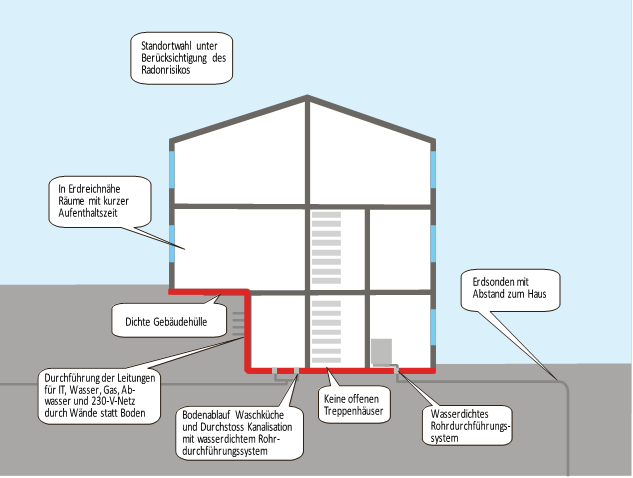
Measures to protect against radon
7. Summary: What to do about radon in the basement?
Radon is an invisible but serious risk. Buildings in the Erzgebirge (Saxony), the Black Forest (Baden-Württemberg), the Fichtelgebirge, the Bavarian Forest (Bavaria) and the Harz Mountains are particularly affected. The good news is that radon can be reliably measured and effectively reduced.
With the right combination of the following measures, radon levels in your home can be permanently reduced:
- Ventilation
- Sealing
- Dehumidification
- Structural measures
Haustrocknung.de supports you competently and reliably.

Contact us without obligation
Do you have any further questions or may we prepare an offer for you?
Get in touch with us without obligation. We look forward to your inquiry!
Get in touch with us without obligation. We look forward to your inquiry!
Tobias Bayer
Managing Director